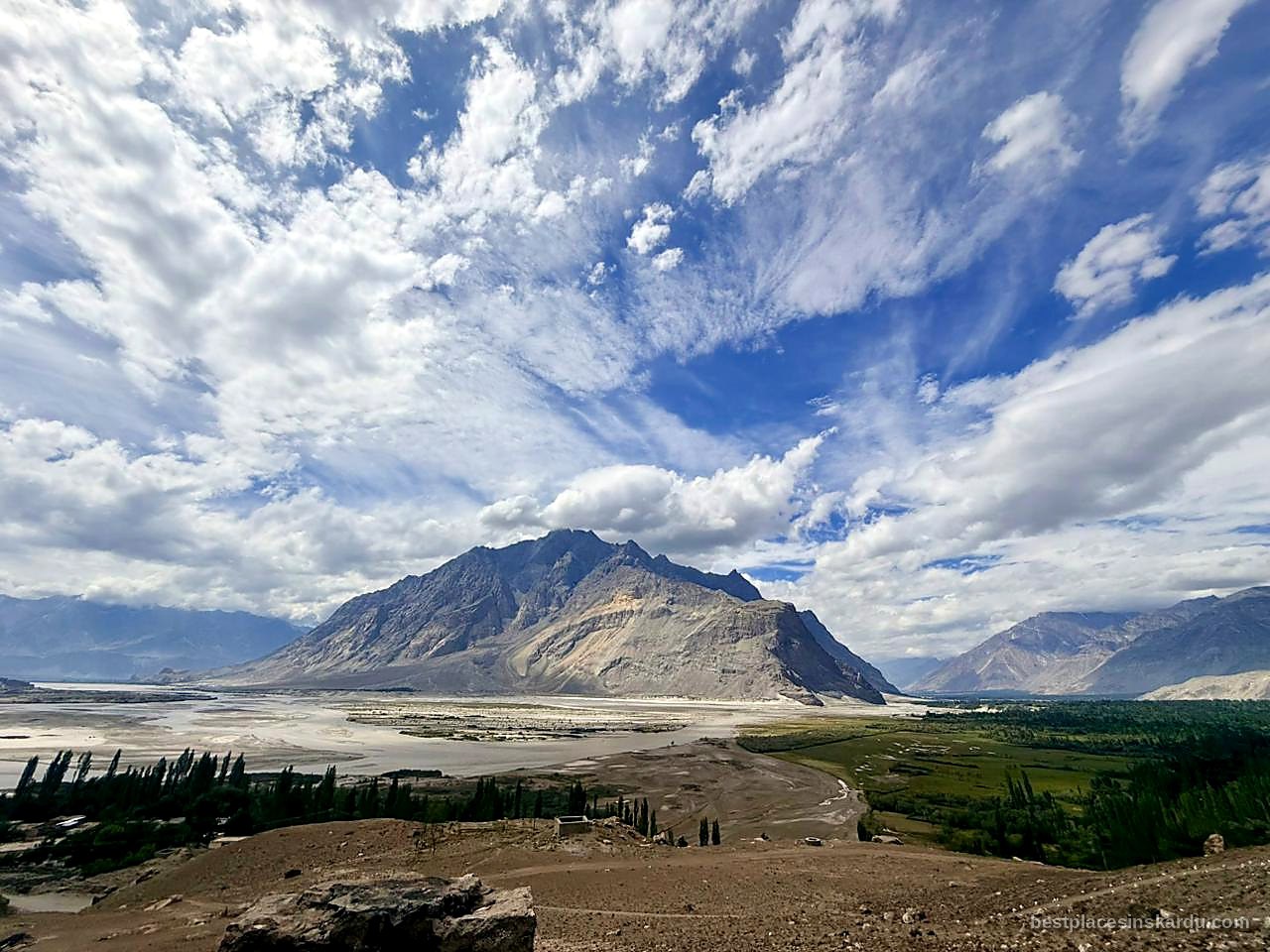
Weather in Skardu today, right now
The panel above pulls Skardu weather today directly from a live feed each time this page loads, so the temperature shown is current rather than an average. It reports the town at 2,228 m alongside the Deosai plateau at 4,114 m, because the two differ by 10–15°C on the same day and a single figure misleads people into underpacking.
What the live panel shows: current temperature, what it feels like, wind speed, humidity, and a 7-day forecast with rain probability. If you are checking the weather near Skardu before a drive, the destination table further down gives the difference at each location.
Data updates on every page load. If the panel shows a fallback message, the weather service is temporarily unreachable — reload in a few minutes.
Skardu snowfall season: when it snows and what closes
Snow is the single factor that decides what you can and cannot reach in Baltistan. Skardu town itself gets moderate accumulation; the high ground gets far more and holds it for months, and that is what shuts the roads.
| Month | Snow in Skardu town | What is closed |
|---|---|---|
| November | First falls, usually light | Deosai closed. Babusar Pass closes late Oct–early Nov. |
| December | Regular snowfall | Deosai, Babusar, most high valleys |
| January | Heaviest of the year | Everything above the valley floor |
| February | Heavy | Everything above the valley floor |
| March | Reducing, still possible | Deosai and Babusar still closed |
| April – May | Rare in town | Deosai usually still closed; Babusar closed |
| June | None in town | Babusar opens early-to-mid month; Deosai opens |
| July – October | None in town | Nothing closed by snow |
The short version: snow falls in Skardu town from roughly November through March, heaviest in January and February. High passes and the plateau hold snow considerably longer, which is why Deosai only opens around June and why Babusar Pass follows almost the same calendar.
Skardu under snow is genuinely striking, and the cold desert dunes with a dusting on them are an unusual sight. But flights cancel more often in winter, many valley properties close, and most of what people come for is unreachable. See the best month to visit for the full seasonal trade-off.
The table below pulls current conditions for nine locations at once, from Islamabad at 507 m to Sheosar Lake at 4,250 m. The last column shows how each compares with Skardu town on the same day, which is the number that actually affects what you pack.
Live weather across the Skardu region
Every place on this site, side by side, updated when you load the page.
| Location | Now | Conditions | Today's range | Wind | vs Skardu |
|---|---|---|---|---|---|
| Loading live conditions for nine locations… | |||||
Weather near Skardu: how far the forecast travels
A Skardu town forecast covers Skardu town. It does not describe the places you will actually spend your days, and the gap is larger than most visitors expect.
Within an hour's drive the elevation ranges from 2,228 m in the city to 2,636 m at Satpara. Within three hours it reaches 4,250 m at Sheosar. That is a spread of more than two kilometres of vertical, and roughly 15°C of difference on the same afternoon.
The live board above queries nine locations separately for exactly that reason — Islamabad, Skardu, the Kachura lakes, Sarfaranga, Khaplu, Kharmang, Manthokha, the Deosai plateau and Sheosar Lake. The last column shows each against Skardu town, which is the number that decides what you pack.
Weather at each Skardu destination
The board includes Upper Kachura Lake and Shangrila Resort separately: Upper Kachura is slightly higher and more exposed, so it runs a little cooler and windier. Basho Valley weather is also tracked independently, as the valley runs wetter and greener than the main Skardu basin.
A single Skardu forecast is misleading, because the places you visit span more than 2,000 metres of vertical. This table gives the practical difference at each location relative to the town forecast above.
| Location | Elevation | Difference vs town | What that means |
|---|---|---|---|
| Skardu city | 2,228 m | Baseline | What the forecast above reports |
| Sarfaranga Cold Desert | ~2,300 m | Similar by day, colder at night | Open sand: no shade, strong wind, and the surface cools fast after sunset |
| Shangrila / Lower Kachura | ~2,500 m | 1–2°C cooler | Sheltered by trees; calm mornings, breeze builds by midday |
| Upper Kachura Lake | ~2,500 m | 1–2°C cooler | As above, slightly more exposed |
| Satpara Lake | 2,636 m | 2–3°C cooler | On the Deosai road; the cooling starts here |
| Shigar valley | ~2,300 m | Similar to town | Orchards moderate the temperature |
| Khaplu | 2,600 m | 2–3°C cooler | Colder nights than Skardu year-round |
| Basho Valley | ~2,900 m | 4–5°C cooler | Cold nights even in July |
| Deosai plateau | 4,114 m | 10–15°C cooler | Near-freezing nights all season |
| Sheosar Lake | 4,250 m | 12–16°C cooler | Coldest point on any normal itinerary |
Sheosar Lake and Deosai weather
Sheosar Lake weather in one line: 12–16°C colder than Skardu town on the same day, with near-freezing nights even in July. Sheosar Lake sits at 4,250 metres on the western edge of the Deosai plateau, which makes it the coldest place most visitors to Skardu will stand. The live board above pulls its conditions separately, because a Skardu town forecast is close to useless for planning a day here.
| Month | Day | Night | What to expect |
|---|---|---|---|
| June | 8–14°C | Around freezing | Snow patches still on the shore. Road only just open. |
| July | 12–18°C | 2–6°C | Warmest of the year. Wildflowers at their peak. |
| August | 12–18°C | 2–6°C | Most reliable conditions. Busiest. |
| September | 8–15°C | Near or below freezing | Clearest air of the year. Colder nights. |
| October | 3–10°C | Below freezing | Closing risk rises through the month. |
| Nov–May | Snowbound and unreachable. The road is closed. | ||
How much colder is Sheosar than Skardu?
Typically 12 to 16°C colder on the same day. A 26°C afternoon in Skardu city can mean single figures at the lakeshore, and dawn temperatures at or below freezing even in July and August. That gap is the single most useful thing to know before you set off, and it is why people arrive underdressed.
Wind is the factor people underestimate
The plateau is open in every direction with nothing to break the wind. Still conditions in Skardu town tell you nothing about conditions at the lake, and wind chill at 4,250 m makes a moderate temperature feel considerably worse. Check the live board above rather than the town forecast.
When you can reach Sheosar
Roughly mid-June to late September, occasionally into October. Outside that window the road is snowbound. See Deosai National Park for the current open status and both routes in.
Upper Kachura Lake weather
Upper Kachura Lake weather runs 1–2°C cooler than Skardu town. The lake sits at around 2,500 m, a little higher and more exposed than Shangrila / Lower Kachura next door, so expect more wind off the water and cold mornings even in summer. Both are shown separately in the board above. The lake is accessible whenever Skardu is, with no seasonal closure. Visiting details are in our Upper Kachura Lake guide.
Shangrila Resort and Lower Kachura Lake weather
Lower Kachura Lake at Shangrila Resort sits at roughly 2,500 m — warmer than Upper Kachura and well sheltered. Weather here is close to Skardu town, typically 1–2°C cooler, with calm mornings and a breeze building by midday. Entry is PKR 1,000–1,500; see the Shangrila Resort guide for visiting details.
Basho Valley weather
Basho runs considerably wetter and greener than the Skardu basin — the valley faces the prevailing moisture and gets more precipitation. Temperatures are similar to Skardu town in summer, but afternoon cloud builds more reliably. The board above tracks it separately.
Sarfaranga cold desert weather
Sarfaranga cold desert weather tracks Skardu town by day, then turns cold fast after sunset. Sarfaranga sits on the valley floor at around 2,300 metres, so daytime temperatures are close to Skardu town. What makes it feel different is the surface and the exposure.
- Daytime: sand reflects heat, so it feels warmer than the air temperature in direct sun
- After sunset: it cools sharply — this is a cold desert, and the drop is fast
- Wind: the same valley wind that built the dunes blows across them, strongest midday to late afternoon
- Shade: effectively none, so UV exposure is high regardless of the temperature reading
Late afternoon is both the best light and the most comfortable temperature. See the Sarfaranga Cold Desert guide for safari prices and what to bring.
Skardu altitude and why it matters for weather
Skardu town sits at 2,228 metres (7,310 feet). That is high enough for cold nights year-round and strong UV, but low enough that altitude sickness is uncommon. The problems start on day trips: Deosai at 4,114 m and Sheosar at 4,250 m are reached in under three hours from town, which is a faster ascent than any acclimatisation guideline recommends. Our high altitude guide covers acclimatization, symptoms and when to descend.
Why altitude matters more than season here
A single Skardu forecast is misleading, because the places you will visit span more than 2,000 metres of vertical. On the same July day Skardu town might sit at a pleasant 25°C while Sheosar Lake on Deosai hovers near 5°C with wind.
| Location | Elevation | Difference vs town |
|---|---|---|
| Skardu city | 2,228 m | Baseline, what forecasts report |
| Kachura lakes | 2,500 m | Marginally cooler |
| Basho meadows | 2,900 m | 4–5°C cooler, cold nights year-round |
| Deosai plateau | 4,114 m | 10–15°C cooler, near-freezing nights |
| Sheosar Lake | 4,250 m | Coldest point on a normal itinerary |
Rain, wind and sun
Skardu sits in a rain shadow and is arid by most standards. The valley's agriculture depends on glacial irrigation rather than rainfall. Deosai, facing the monsoon-affected outer Himalaya, gets noticeably more precipitation and summer afternoon showers are common. A dry forecast in town does not guarantee a dry day on the plateau.
Valley winds pick up through the middle of the day, which matters for lake reflections and comfort on the cold deserts. UV exposure at this altitude is far stronger than the temperature suggests. Sunburn on an overcast 15°C day at Deosai is entirely possible.
Skardu weather September 2026: what to expect
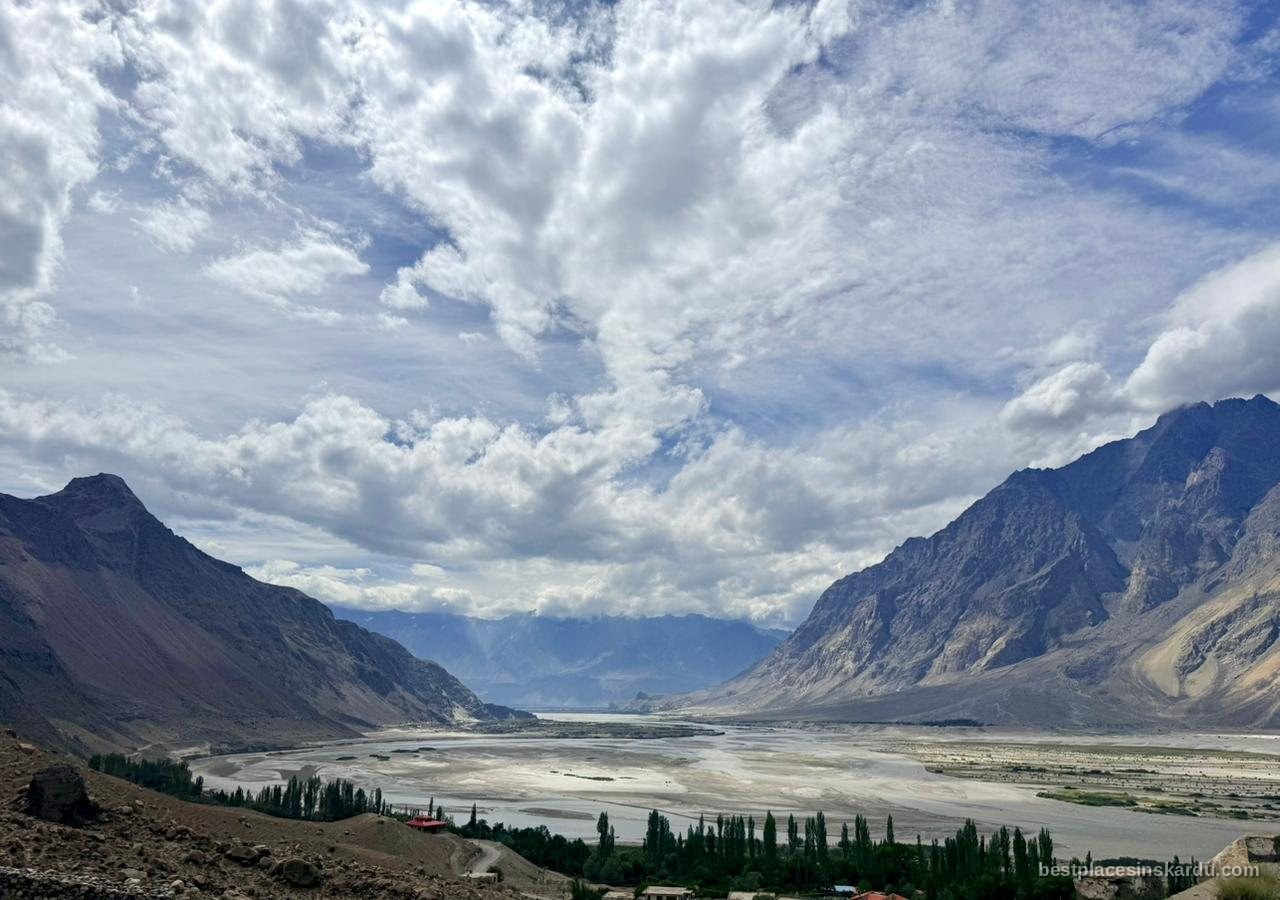
Searching for Skardu weather September 2026? September is the month most travellers ask about, and with reason. Daytime highs in Skardu town typically run 18–26°C, nights drop into single figures, and the air is the clearest it gets all year once the summer haze has cleared.
| Period | Skardu town | Deosai plateau | Notes |
|---|---|---|---|
| 1–10 Sept | 20–26°C day, 8–12°C night | Cold, near freezing at dawn | Effectively summer conditions, fewer crowds |
| 11–20 Sept | 18–24°C day, 6–10°C night | Colder, first snow possible | Best light of the year; poplars starting to turn |
| 21–30 Sept | 15–22°C day, 4–8°C night | Closing risk rises | Confirm Deosai road status locally before travelling |
The practical point for September: everything is still open at the start of the month and may not be by the end. If Deosai is essential to your trip, book the earlier half. Check the live panel above for current conditions rather than relying on averages.
Skardu weather in October
Skardu temperature in October runs about 11–20°C by day, with nights falling to single figures and close to freezing by the end of the month. Skies stay mostly clear and dry, and the poplars and orchards turn gold from the last week of September to mid-October.
- Deosai and Sheosar Lake: 3–10°C by day and below freezing at night; the plateau road can close at any point in the month
- Babusar Pass: usually closes late October to early November, leaving the Karakoram Highway as the road route
- What to pack: a warm jacket for evenings and anything above Satpara, plus sun protection for the day
For how October compares with September as a travel month, see Skardu in October.
Weather by season
Summer (June–August)
Daytime highs in the low-to-high 20s°C, single digits overnight. Warmest and driest, with occasional afternoon showers.
Autumn (September–October)
Highs in the high teens, noticeably colder nights, and the clearest skies of the year. See autumn in Skardu.
Winter (November–March)
Regular snowfall, daytime highs near or below freezing, and Deosai completely inaccessible.
Spring (April–May)
Mild and warming, blossom in the orchards, but high-altitude routes still closed.
How weather affects your plans
- Flights: the Islamabad–Skardu route runs on visual flight rules and is weather-cancellable year-round. Build a buffer day.
- Deosai access: the unpaved track becomes difficult after heavy rain even in season.
- Basho and Kharmang roads: both vulnerable to closure after significant rainfall.
For seasonal planning rather than day-of conditions, see the best month to visit Skardu.
What to wear in Skardu right now
The forecast above tells you the number; this tells you what to really pack. The recurring mistake visitors make is dressing for Skardu town and then spending a day 2,000 metres higher.
| Skardu town shows | In town | On Deosai the same day |
|---|---|---|
| 25°C or above | T-shirt, sun hat, sunscreen | Fleece plus a windproof shell, it will be near 10°C |
| 18–24°C | Light long sleeves | Insulated jacket, gloves useful |
| 10–17°C | Jacket, layers | Full winter layers; near or below freezing |
| Below 10°C | Winter coat | Deosai is almost certainly closed |
Does weather affect Islamabad–Skardu flights?
Significantly, and more than most travellers expect. Skardu Airport operates largely under visual flight rules, meaning pilots need clear visibility through the mountain passes rather than relying on instrument approaches alone. Cloud at either end can ground a flight.
Morning departures have better completion rates than afternoon ones, because mountain weather generally deteriorates through the day. Always build a buffer day into your itinerary, and never schedule an international connection for the same day as your Skardu departure. Full detail on the Islamabad to Skardu route guide.
Rain, snow and road closures
Wind matters more than rain for the lakes. Still mornings give the clean reflections people come for at Shangrila and Upper Kachura; by midday the valley breeze usually breaks the surface.
Skardu itself is arid, it sits in a rain shadow and the valley's agriculture depends on glacial irrigation rather than rainfall. But rain matters more than the small totals suggest, because it closes roads:
- Deosai track: becomes difficult or impassable after heavy rain, even within the June–September season
- Basho Valley approach: the unpaved final stretch is the first to close
- Kharmang road (Manthokha): vulnerable to landslide and rockfall after sustained rain
- Skardu Road (S1): generally reliable but occasionally affected by rockfall
Local drivers know current conditions far better than any forecast model. If a driver advises postponing, take the advice.
Snowfall in Skardu
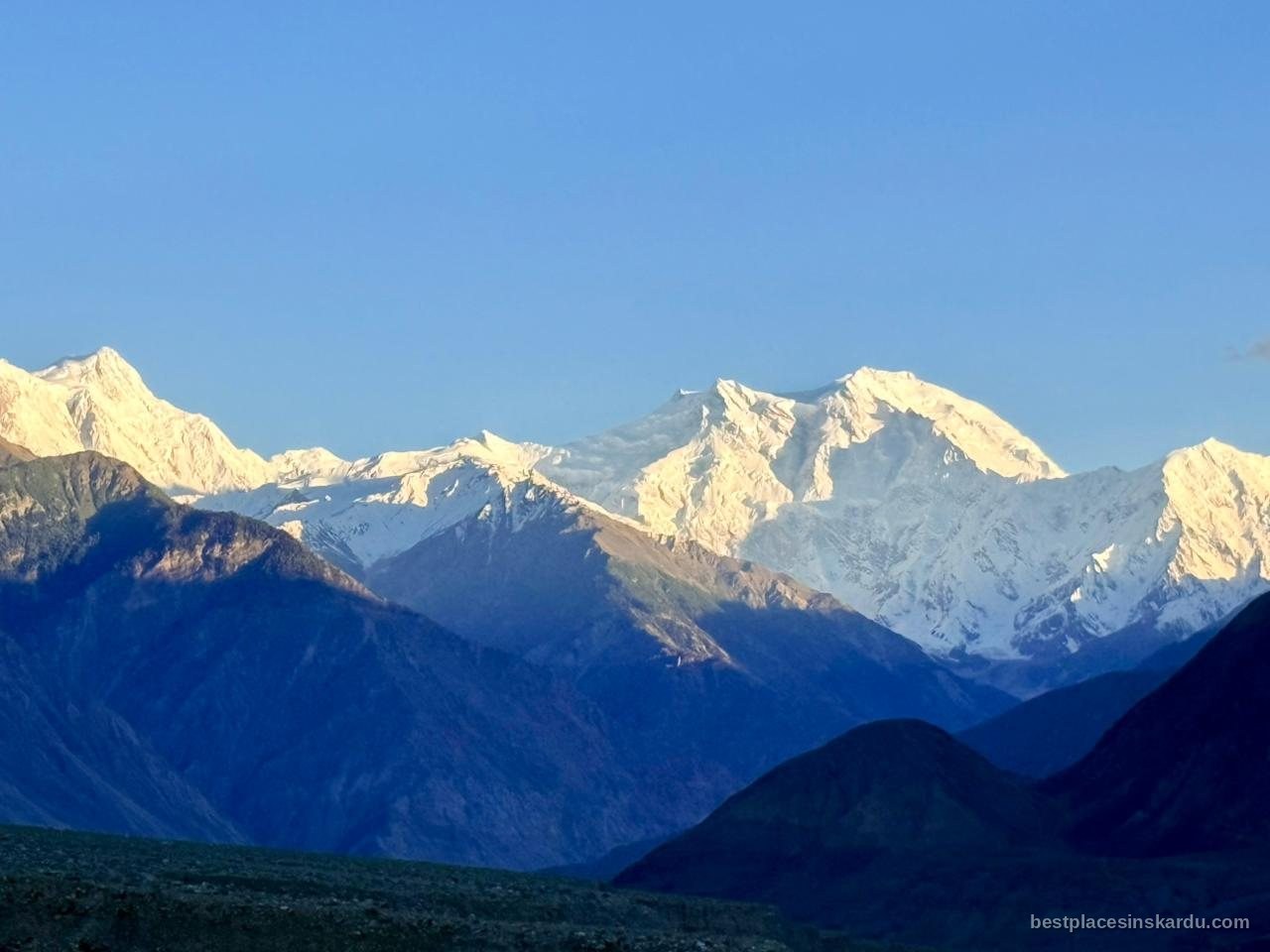
Snow falls regularly in Skardu town from roughly November through March, with daytime highs near or below freezing at the coldest point of winter. The surrounding high valleys and Deosai receive far heavier and longer-lasting snow, closing them entirely from around October to May.
Winter Skardu is truly beautiful under snow, and the cold desert dunes under a dusting are an unusual sight. But most of the region's headline attractions are inaccessible, so it suits repeat visitors more than first-timers.
UV and sun exposure
This applies most sharply on open ground with no shade. The dunes at Sarfaranga and the Deosai plateau both reflect light upward as well as down, which is how people burn on cool, overcast days.
This is the most underestimated weather factor in Baltistan. UV intensity at 2,228 metres is substantially higher than at sea level, and on Deosai at 4,114 metres it is higher again. Sunburn on an overcast 15°C day is entirely possible, and glare off snow or glacier ice is severe enough to warrant proper eye protection.
Carry high-factor sunscreen and real sunglasses regardless of the temperature reading or cloud cover. This applies in every month, not just summer.
Planning a first visit? We have written up first-time notes on visiting Skardu on our travel blog.
Frequently asked questions
How much colder is Deosai than Skardu?
Typically 10 to 15°C colder on the same day, given the roughly 2,000 metre elevation difference. Pack an insulated jacket even for a summer day trip.
Is Skardu colder than Islamabad?
Yes, substantially. Skardu sits at 2,228 metres versus Islamabad's roughly 500 metres, so expect cooler temperatures year-round and a genuine winter rather than Islamabad's milder cold season.
What is the weather in Skardu in September 2026?
Daytime highs in Skardu town typically run 18 to 26°C in September, dropping through the month, with nights in single figures. Skies are the clearest of the year. Deosai runs far colder and the road can close in the last week.
What is Skardu's altitude?
Skardu town sits at 2,228 metres (7,310 feet). That means cold nights year-round and strong UV, but altitude sickness is uncommon in the town itself. Day trips to Deosai at over 4,000 metres are a different matter.
What is the Sarfaranga cold desert weather like?
Sarfaranga cold desert weather runs close to Skardu town by day at around 2,300 metres, but the sand reflects heat in direct sun and cools sharply after sunset. No shade, and the valley wind peaks from midday to late afternoon.
What is the weather in Skardu today?
The live panel at the top of this page shows Skardu weather today — current temperature, feels-like, wind and humidity — pulled fresh each time the page loads. It reports Skardu town and the Deosai plateau separately, because they differ by 10 to 15°C on the same day.
What is the temperature in Skardu right now?
The live panel shows the current Skardu temperature. Bear in mind that the weather near Skardu varies sharply with elevation: Sheosar Lake at 4,250 m runs 12 to 16°C colder than the town.
When does it snow in Skardu?
Snow falls in Skardu town from roughly November through March, heaviest in January and February. The high valleys and the Deosai plateau hold snow far longer, which is what keeps Deosai and Babusar Pass closed until around June.
Can I see live weather for Deosai and Sheosar Lake?
Yes. The live board on this page shows current conditions for nine locations at once — Islamabad, Skardu, Shangrila and the Kachura lakes, Sarfaranga, Khaplu, Kharmang, Manthokha, the Deosai plateau and Sheosar Lake — with each compared against Skardu town.
What is the weather at Sheosar Lake?
Sheosar Lake sits at 4,250 m and runs 12 to 16°C colder than Skardu town on the same day. July and August are warmest at 12 to 18°C by day, dropping to 2 to 6°C at night. It is snowbound and unreachable from November to May.
What is the weather near Skardu?
It depends entirely on elevation. Within three hours of the city the ground rises from 2,228 m to 4,250 m, a difference of roughly 15°C on the same afternoon. The live board on this page shows nine locations separately, each compared against Skardu town.
How cold is Sheosar Lake in September?
Days run 8 to 15°C and nights fall to or below freezing. September has the clearest air of the year at Sheosar, but the road closing risk rises through October.
What is the weather at Upper Kachura Lake?
Upper Kachura Lake runs about 1–2°C cooler than Skardu town and is windier, as it is slightly higher and more exposed than Shangrila. It is reachable all year; the live board on this page shows it separately.
What is the weather at Shangrila Resort?
Shangrila Resort and Lower Kachura Lake sit at about 2,500 m and run 1–2°C cooler than Skardu town, with calm mornings and a breeze by midday. The live board on this page shows current conditions.
What is Basho Valley weather like?
Basho Valley runs wetter and greener than the Skardu basin — it faces the prevailing moisture and gets more cloud. Temperatures are similar to Skardu town in summer. The weather board on this page tracks Basho Valley separately.
What is the average temperature in Skardu?
Skardu averages around 33°C maximum in July and drops to about minus 8°C minimum in January. Spring and autumn sit between 15°C and 26°C in the day. The month-by-month table on this page gives the full range.
How cold does Skardu get in winter?
January is the coldest month, averaging a maximum around 6°C and a minimum near minus 8°C. Deosai and Sheosar Lake are far colder and effectively inaccessible from November to May.
What is the weather in Skardu in October?
Daytime temperatures in Skardu town run about 11–20°C in October, with cold nights near freezing by the end of the month. Skies are mostly clear. Deosai can close during the month and Babusar Pass usually shuts late October to early November.